If you’ve tried two or more antidepressants without meaningful improvement, you’re dealing with what clinicians call treatment-resistant depression, or TRD. It affects roughly a third of people diagnosed with major depression, and if you’re reading this, you probably already know how frustrating the cycle of switching medications can be.
The good news: there are now two treatments that work through an entirely different mechanism than the antidepressants that haven’t worked for you. Both are available at NY Ketamine Infusions, and understanding the differences can help you and your provider decide which path makes sense.
How Both Treatments Work (And Why They’re Different From Antidepressants)
Traditional antidepressants — SSRIs like Prozac or Zoloft, SNRIs like Effexor or Cymbalta — work by increasing serotonin or norepinephrine activity in the brain. They take 4–8 weeks to show effects, and for patients with TRD, they often don’t work at all.
Ketamine and Spravato both target a completely different system: the glutamate pathway and NMDA receptors. This triggers a cascade that increases communication between neurons, promotes the growth of new neural connections (neuroplasticity), and can produce noticeable mood improvement within hours or days rather than weeks.
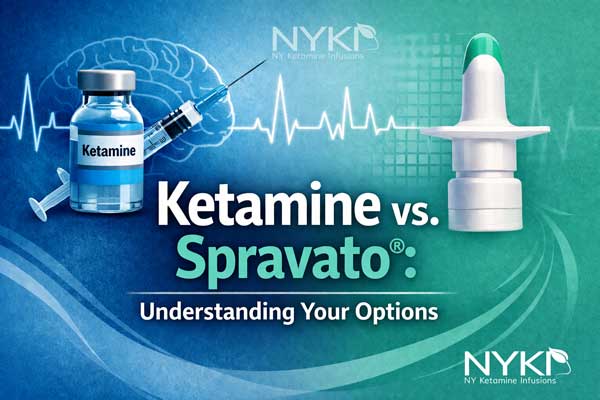
The difference between the two isn’t how they work, it’s how they’re delivered, dosed, and paid for.
The Key Differences
| IV Ketamine | Spravato® (Esketamine) | |
|---|---|---|
| What it is | Racemic ketamine (both S and R isomers) delivered by IV | Esketamine (S-isomer only) delivered by nasal spray |
| FDA status | Used off-label for depression | FDA-approved for TRD and major depression with suicidal ideation |
| Session length | 40–60 minutes | ~2 hours (includes required observation period) |
| Typical course | 6 infusions over 2–3 weeks, then boosters as needed | 2x/week for 4 weeks (induction), then weekly or biweekly |
| Insurance | Self-pay ($475–$525 per infusion) | Covered by most major commercial plans and Medicare |
| Out-of-pocket cost | Full session cost | Often as low as $10–$50 per session after insurance with savings programs |
| Dosing flexibility | Dose can be adjusted during infusion based on response | Fixed doses (56mg or 84mg) determined by provider |
Which One Is Right for You?
Spravato may be a better fit if:
You have commercial insurance or Medicare and want a treatment that’s covered. The Janssen withMe savings program can reduce your copay to as low as $10 per session. As of January 2025, Spravato is FDA-approved as a standalone treatment, meaning you no longer need to be on an oral antidepressant to qualify.
IV ketamine may be a better fit if:
You’re looking for maximum dosing flexibility, prefer a shorter session time, or have a condition like anxiety or PTSD where off-label ketamine has supporting research but Spravato doesn’t carry an FDA indication. IV ketamine is also available immediately as there’s no insurance authorization process to wait through.
Some patients start with one and transition to the other. A patient might begin with IV ketamine for rapid stabilization and then move to Spravato for insurance-covered maintenance. Others try Spravato first and switch to IV if they want more control over dosing. Your provider can help determine the best approach based on your clinical history and insurance situation.
What the Research Shows
Clinical studies, including work from Yale and the National Institutes of Health, have consistently shown that ketamine-based treatments produce meaningful improvement in roughly 60–70% of patients with TRD. Many patients notice changes within 24 hours of their first session — a timeline that’s unprecedented compared to traditional antidepressants.
Both treatments have over five years of real-world clinical data supporting their safety and efficacy when administered in a supervised medical setting.
What Happens Next
If you’re considering either treatment, the first step is a consultation. We’ll review your treatment history, discuss your insurance options, and recommend a path forward based on your specific situation.
For Spravato, we handle insurance verification and prior authorization at no cost to you. For IV ketamine, no authorization is needed, and you can typically begin within days of your consultation.
Schedule a consultation: NYC (FiDi): (917) 261-7370 Long Island (Melville): (631) 629-4626
Or visit nyketamine.com to learn more.
Frequently Asked Questions
How fast does ketamine work for depression? Many patients report improvement within hours to 24 hours after their first session, significantly faster than the 4–8 weeks typical of oral antidepressants.
Is Spravato covered by my insurance? Spravato is FDA-approved and covered by most major commercial insurance plans and Medicare. We verify your benefits before your first appointment at no charge.
Is ketamine therapy safe? Both IV ketamine and Spravato are administered in a clinical setting with medical supervision and vital sign monitoring. Side effects — including temporary dissociation, dizziness, and nausea — typically resolve within the session or the same day.
How many treatments will I need? IV ketamine typically starts with 6 infusions over 2–3 weeks, followed by periodic boosters. Spravato follows a structured schedule: twice weekly for 4 weeks, then weekly or biweekly on an ongoing basis.
Can I do ketamine for anxiety or PTSD? IV ketamine has emerging research supporting its use for anxiety disorders and PTSD. Spravato is currently FDA-approved only for TRD and major depression with suicidal ideation.
Do I need to be on an antidepressant to get Spravato? Not anymore. As of January 2025, Spravato is approved as a standalone (monotherapy) treatment for TRD.