Seasonal Depression: Symptoms, Treatments & How Ketamine Works
Seasonal affective disorder (SAD) is more than the winter blues. Learn why seasonal depression happens, which treatments are supported by research, and when ketamine-based therapy may be considered for treatment-resistant depression.
Serving Manhattan, New York City and Melville, Long Island.
Request a Consultation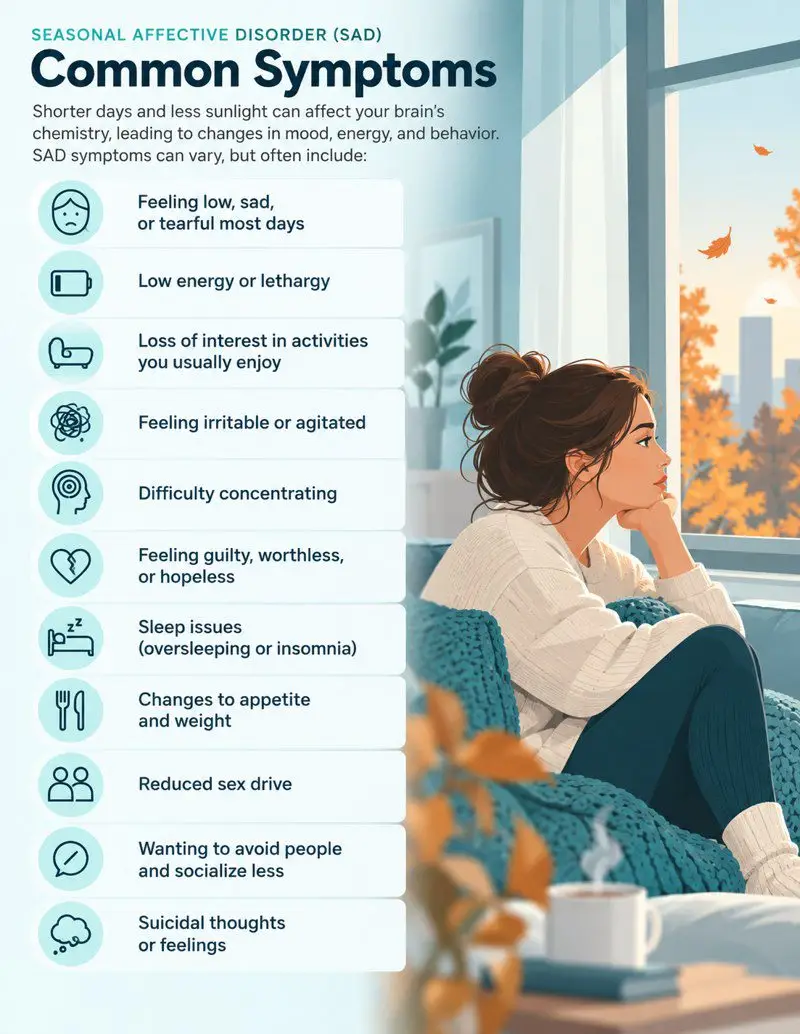
Quick answer: Seasonal affective disorder (SAD) is a form of depression with a recurring seasonal pattern, usually beginning in fall or winter. Light therapy, cognitive behavioral therapy and antidepressants are established treatments. Ketamine is not an FDA-approved or established SAD-specific treatment, but may be considered for an independently diagnosed treatment-resistant depressive disorder following clinical evaluation.
As days grow shorter, some people experience persistent sadness, fatigue, changes in sleep, and loss of interest in everyday activities. These symptoms can signal seasonal depression rather than an ordinary reaction to winter weather. Effective care begins with understanding the condition and matching treatment to the person's diagnosis and medical history.
What Is Seasonal Depression (SAD)?
Seasonal affective disorder is depression characterized by recurring episodes that follow a seasonal pattern. Most episodes begin in fall or winter and improve during spring, although a less common summer pattern also occurs.
Clinicians may diagnose major depressive disorder with seasonal pattern when the relevant criteria are met. A seasonal pattern can also occur in bipolar disorder, making accurate assessment important.
Seasonal depression can disrupt work, relationships, concentration, sleep, and quality of life. It is not simply a lack of motivation or a normal response to cold weather.
Source: National Institute of Mental Health — Seasonal Affective Disorder
Winter Blues vs. Seasonal Depression
| Winter blues | Seasonal depression |
|---|---|
| Usually mild and temporary | Clinically significant depressive symptoms |
| Daily functioning largely intact | Work and relationships may be affected |
| May improve with routine changes | May require professional treatment |
| Not necessarily a diagnosis | Requires a clinical assessment |
Symptoms and Causes of Seasonal Depression
Common signs of winter-pattern SAD
- Persistent sadness, hopelessness or loss of interest
- Low energy and excessive fatigue
- Sleeping longer or struggling to wake up
- Carbohydrate cravings or increased appetite
- Difficulty concentrating or making decisions
- Social withdrawal, irritability or anxiety
- Feelings of guilt or worthlessness
Summer-pattern episodes may involve insomnia, decreased appetite, agitation, or anxiety. Symptoms that last at least two weeks or interfere with functioning warrant professional evaluation.
Why does seasonal depression happen?
Shorter days can disrupt biological timing and sleep-wake cycles.
Seasonal changes may influence brain systems involved in mood regulation; SAD is not simply a serotonin deficiency.
Altered daylight exposure can affect sleep timing and daytime alertness.
Lower sunlight may reduce vitamin D production, but supplementation has not consistently been shown to treat SAD.
How Ketamine Works for Seasonal Depression
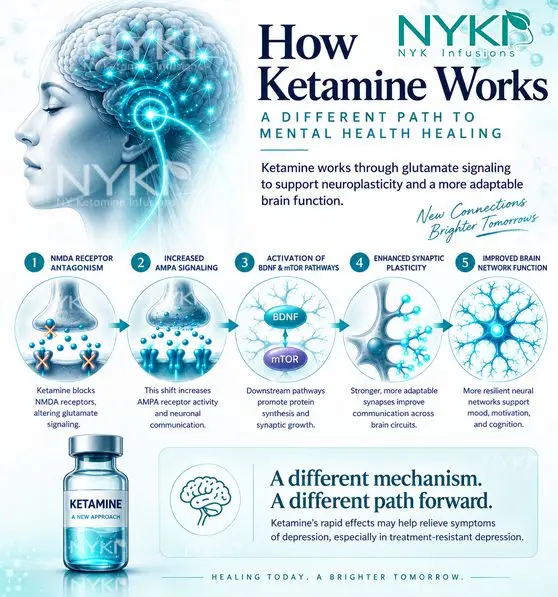
Ketamine acts on glutamate-related brain signaling and can produce relatively rapid antidepressant effects in some patients with treatment-resistant major depression. Its relevance to seasonal depression is an extrapolation from broader depression research—not proof of a SAD-specific benefit.
1. NMDA receptors
Ketamine blocks NMDA receptors, changing glutamate signaling in the brain.
2. AMPA signaling
Downstream signaling through AMPA receptors may contribute to antidepressant effects.
3. Neuroplasticity
Research links ketamine to BDNF, mTOR, and pathways involved in synaptic plasticity.
4. Rapid response
Some patients with treatment-resistant depression improve within hours or a day, though responses vary.
Important distinction: Ketamine does not replace sunlight, correct a circadian rhythm disorder, or directly reverse a known cause of SAD. Evidence for its rapid antidepressant effects comes primarily from studies of major depression and treatment-resistant depression.
Why glutamate and neuroplasticity matter
Glutamate is the brain's main excitatory neurotransmitter. By changing NMDA and downstream AMPA signaling, ketamine can influence networks involved in mood, stress response and neural adaptation.
Preclinical research implicates brain-derived neurotrophic factor (BDNF) and mTOR signaling in changes to synaptic function. The full mechanism in humans is still being studied.
These pathways are different from the primary targets of many conventional antidepressants. However, a different mechanism does not mean ketamine is proven for every subtype of depression.
Can Ketamine Treat Seasonal Affective Disorder?
Ketamine is not an established or FDA-approved treatment specifically for SAD. Intravenous ketamine is FDA-approved as an anesthetic, and psychiatric use is off-label. SPRAVATO® (esketamine) is FDA-approved for specified adult depression indications, but not specifically for seasonal affective disorder.
Someone with seasonal depressive episodes may also have major depressive disorder that is treatment-resistant. If conventional therapies have not worked adequately, a clinician may evaluate whether ketamine-based care is appropriate for the underlying depressive disorder.
Clinical response is not guaranteed. Benefits may be temporary, and treatment requires appropriate monitoring and follow-up.
What the evidence does—and does not—show
- Supported: IV ketamine can have rapid antidepressant effects in some patients with treatment-resistant depression.
- Supported: Esketamine has FDA-approved indications for certain adult depressive conditions.
- Not established: Ketamine specifically treats the seasonal pattern or underlying daylight-related factors in SAD.
- Requires assessment: Whether an individual with seasonal episodes also qualifies for another depression treatment pathway.
What Are the Best Treatments for Seasonal Depression?
For SAD itself, established treatment options include light therapy, specialized psychotherapy, and antidepressant medication. The appropriate approach depends on symptoms, medical history, and diagnosis.
Bright light therapy
Morning exposure to a therapeutic light box, commonly 10,000 lux for about 30–45 minutes, may help winter-pattern SAD. Consult a clinician if you have bipolar disorder, certain eye conditions or photosensitizing medications.
CBT for SAD
Cognitive behavioral therapy adapted for seasonal depression (CBT-SAD) addresses unhelpful thinking patterns and promotes activity and coping skills. It may help prevent future seasonal episodes.
Antidepressants
Medication may be appropriate for moderate or severe symptoms. Bupropion XL has an FDA-approved indication for preventing seasonal major depressive episodes in selected adults.
| Approach | Role | Key consideration |
|---|---|---|
| Light therapy | Established for winter-pattern SAD | Timing and suitability matter |
| CBT-SAD | Evidence-based psychotherapy | Can address recurring patterns |
| Antidepressants | For selected patients | Require clinician-guided prescribing |
| Vitamin D | Correct deficiency if present | Inconsistent evidence as SAD treatment |
| Ketamine-based therapy | Possible option for qualifying underlying depressive disorders | Not an established SAD-specific treatment |
Supportive habits—consistent sleep, outdoor daylight exposure, physical activity, and social connection—can complement professional treatment, but should not substitute for care when depression is severe.
IV Ketamine vs. SPRAVATO® for Depression
Both approaches affect glutamate-related pathways, but their regulatory status and delivery differ. Neither is FDA-approved specifically for seasonal affective disorder.
| Feature | IV ketamine | SPRAVATO® (esketamine) |
|---|---|---|
| Administration | Intravenous infusion | Nasal spray in a certified setting |
| Depression FDA approval | Off-label | Approved for specified adult depression indications |
| SAD-specific approval | No | No |
| Monitoring | Medical supervision during and after infusion | At least 2 hours after dosing under REMS |
| Insurance | Often not covered for depression | May be covered when plan criteria are met |
SPRAVATO® has important risks and restrictions, including sedation, dissociation, respiratory depression and misuse potential. Treatment suitability and insurance eligibility require individual assessment.
When Should You Seek Help?
Talk with a qualified mental health professional if symptoms last two weeks or more, return at the same time each year, or interfere with work, relationships or daily functioning.
- Depression is getting worse rather than improving
- Sleep, appetite or energy changes are significant
- Previously helpful treatments no longer work
- Symptoms continue outside the expected season
- You have a history of mania or hypomania
In a crisis: If you or someone else is at immediate risk, call 911. In the U.S., call or text 988 for the Suicide & Crisis Lifeline.
Seasonal Depression vs. Treatment-Resistant Depression
Seasonal depression describes when depressive episodes recur.
Treatment-resistant depression describes how a depressive disorder has responded to adequate treatments.
A person may have both. Assessment can also identify other conditions—such as bipolar disorder, thyroid disorders or sleep disorders—that influence treatment choices.
Depression Treatment in New York City & Long Island
New York Ketamine Infusions offers evaluations and medically supervised ketamine-based treatment for appropriate patients with depressive disorders at two locations. A seasonal pattern alone does not establish eligibility.
Manhattan — New York City
New York Ketamine Infusions
160 Broadway, 16th Floor
New York, NY 10038
Serving Manhattan and surrounding New York City communities.
Melville — Long Island
New York Ketamine Infusions
150 Broadhollow Road, Suite 103
Melville, NY
Serving Nassau County, Suffolk County and surrounding Long Island communities.
Frequently Asked Questions About Seasonal Depression
When does seasonal depression usually start?
Winter-pattern seasonal depression typically begins in fall or early winter as daylight decreases and improves in spring. Some people instead experience summer-pattern episodes.
What month is seasonal depression the worst?
There is no universal worst month. For winter-pattern SAD in New York, symptoms may be particularly difficult during December, January or February, but individual timing varies.
Does seasonal depression go away on its own?
Symptoms may improve as seasons change, but they can recur in future years. Professional care can reduce current symptoms and help plan for future episodes.
Can seasonal depression cause anxiety?
Yes. Anxiety, irritability and restlessness can accompany seasonal depression. A clinical evaluation can identify co-occurring conditions.
Is SAD a form of bipolar disorder?
Not necessarily. A seasonal pattern can occur in major depressive disorder or bipolar disorder. A history of manic or hypomanic episodes changes treatment considerations.
Does vitamin D help seasonal depression?
Vitamin D can correct a deficiency, but evidence that supplementation reliably treats SAD is inconclusive. Discuss testing and supplementation with a clinician.
Can light therapy help seasonal depression?
Yes. Bright light therapy is an established option for winter-pattern SAD, although timing, intensity and individual health risks should be reviewed with a clinician.
How quickly does ketamine work for depression?
In studies of treatment-resistant depression, some patients improved within hours or about a day after IV ketamine. Others did not respond, and the same timeline has not been established specifically for SAD.
Can ketamine help when antidepressants have not worked?
Ketamine has shown antidepressant effects in some patients with treatment-resistant depression. Suitability depends on the underlying diagnosis, previous treatments and medical evaluation.
Is ketamine FDA-approved for seasonal depression?
No. IV ketamine is not FDA-approved for psychiatric conditions, and SPRAVATO® is not specifically approved for SAD. SPRAVATO® has approvals for certain adult depressive conditions.
Is SPRAVATO® covered by insurance for seasonal depression?
Coverage depends on the qualifying diagnosis, treatment history and plan requirements. A SAD diagnosis alone does not establish coverage. Learn about insurance coverage.
How can I prevent seasonal depression from returning?
A clinician may recommend a preventive plan involving CBT-SAD, appropriately supervised light therapy, regular sleep habits, or medication. Bupropion XL is approved for preventing seasonal major depressive episodes in selected adults.
Explore Your Depression Treatment Options
Persistent or treatment-resistant depression deserves an individualized evaluation. New York Ketamine Infusions serves patients at our Manhattan and Melville clinics.
Request a ConsultationAuthority Sources and References
- NIMH — Seasonal Affective Disorder. Symptoms, causes and evidence-based treatments.
- NIMH — SAD: More Than the Winter Blues. Patient education.
- NIMH — Rapid Antidepressant Works by Boosting Brain's Connections. Foundational synaptic-plasticity research.
- NIMH — Brain Signal Identifies Responders to Fast-Acting Antidepressant. Research on glutamate-related mechanisms.
- NIMH — Ketamine Lifts Depression via a Byproduct of Its Metabolism. Mechanistic research.
- FDA — SPRAVATO® prescribing information. Verify current label and REMS requirements before publication.
- DailyMed — Bupropion XL labeling database. Verify product-specific prevention indication.
Medical disclaimer: This content is educational and is not a diagnosis or a substitute for professional medical advice. Ketamine treatment decisions require individualized medical and psychiatric assessment. Last editorial update: October 2026.